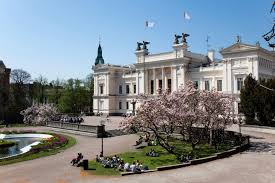
Lund University
Lund University was founded in 1666 and is repeatedly ranked among the world’s top universities. The University has around 46 000 students and 8 500 staff based in Lund, Helsingborg and Malmö. We are united in our efforts to understand, explain and improve our world and the human condition.
Lund University School of Economics and Management is one of eight faculties within Lund University. More than 4 000 students and 450 researchers, teachers and other staff are engaged here in training and research in economic history, business administration, business law, informatics, economics, statistics and research policy.
Lund University School of Economics and Management is accredited by the three largest and most influential accreditation institutes for business schools: EQUIS, AMBA and AACSB. Only just over 100 business schools in the world have achieved this prestigious Triple Crown accreditation.
Health Inequalities Across Time and Space in Sweden, 1968–2023: Long-Term Regional, Social and Environmental Perspectives
The Department of Economic History is a research-intensive department that employs about 80 people: researchers, teachers, technical/administrative staff, and Ph.D. candidates. The department has a large PhD programme and co-ordinates three international Master programmes. The Department has a well-established reputation for wide-ranging research with an emphasis on long-term processes, and with economic theory and quantitative methods as important methodological tools. Strong research areas at the department include economic growth and structural change, innovation, energy and sustainability, development economics, and economic demography, as well as financial history and education and the labour market. More information is available at the Department’s website: www.lusem.lu.se/organisation/department-economic-history.
Assigned duties
Those appointed to doctoral studentship shall primarily devote themselves to their studies, aimed to result in a doctoral degree. Work carried out during the studentship consists of participation in research projects as well as successful participation in postgraduate (third-cycle) courses. Those appointed to doctoral studentships may also work, to a limited extent, with educational tasks and administration at the Department of Economic History. However, duties of this kind may not comprise more than 20 per cent of a full-time post.
The PhD position is linked to the research environment “CIRCE – Centre for Interdisciplinary Research on Cancer and Equity in Women”. The PhD student will work in close collaboration with researchers from both CIRCE and the Centre for Economic Demography, drawing on expertise in economic history, economic demography, health inequalities, segregation, GIScience, environmental science, and cancer research.
Eligibility/Admission Requirements
A person meets the general admission requirements for third-cycle courses and study programmes if he or she has:
- Been awarded a second-cycle degree; or
- Satisfied the requirements for courses comprising of at least 240 credits of which at least 60 credits were awarded in the second-cycle; or
- Acquired substantially equivalent knowledge in some other way in Sweden or abroad. (Higher Education Ordinance, Chapter 7, Section 39)
Specific admission requirements for doctoral studies in each subject are specified in the relevant general syllabus, available at https://www.lusem.lu.se/research/doctoral-studies.
Other requirements
A proficient level of English is required in both written and oral communication. Documented quantitative skills are required.
The following are not required but are strong merits
- experience in statistical programming and statistical analysis
- experience in data management, and working with register data or large micro-level longitudinal databases
- experience in working with health inequalities and/or health register data and/or cancer research
- experience in Geographic Information Systems (GIS), geocoded data, and spatial analysis
Basis of assessment
Admittance of a doctoral student is based on an assessment of the candidate’s ability to benefit from third-cycle studies, see the general syllabus for third-cycle studies, available at https://www.lusem.lu.se/research/doctoral-studies.
The applicant’s ability to benefit from third-cycle studies and research will primarily be assessed on the basis of academic results from the first and second cycle.
- Quality and content of previous written work, such as a Master’s thesis.
- Ability to participate actively in the Department’s research environment.
- Ability to perform independent scientific work.
- Good knowledge of statistics, econometric methods, and quantitative analysis.
- Experience in data management and working with large individual-based or longitudinal databases.
- Experience of, or strong interest in, health inequalities and working with health register data.
- Experience of, or strong interest in, Geographic Information Systems (GIS), spatial analysis, and working with geocoded data.
- Proficiency in written and oral communication in English.
- Relevant educational background in social sciences, for example, in economic history, economic demography, economics, statistics, geography, public or global health, or related disciplines.
- Other relevant experiences for third-cycle education, such as research assistance or advanced analytical work in a research or policy environment.
Applicants should have a strong interest in studying how health inequalities develop across time and space, and should be able to combine a perspective from economic history and health with quantitative and spatial methods.
Project
The project aims to evaluate long-term trends in health inequalities across Swedish regions from the 1970s to the present, with particular focus on inequalities in chronic diseases, especially cancer, and how these trends differ by gender. These patterns will be studied in relation to broader contextual developments, including environmental exposures in residential and occupational settings and other structural and societal changes relevant to population health.
The project adopts a multidimensional approach to inequality, examining how socioeconomic status, country of origin, and regional context interact in shaping health outcomes over time. By combining population register data with spatially detailed environmental information, the project moves beyond traditional socioeconomic analyses of health inequalities.
The project will make use of modern Swedish registers, including health and population registers covering the period 1968–2023, in combination with high-resolution geospatial data. The PhD student will contribute to both the empirical analyses and the methodological development of the project. While interdisciplinary in nature, the project is firmly rooted in economic history through its focus on long-term processes, inequality, and health.
Terms of employment
Fixed-term employment, maximum four years (full-time studies).
Only those admitted to third-cycle courses and study programmes at a higher education may be appointed to doctoral student.
For regulations concerning employment of doctoral students etc., see the Higher Education Ordinance, Chapter 5, Sections 1-7.
For regulations concerning admission to third-cycle courses and study programs, see the Higher Education Ordinance, Chapter 5, Sections 34-41.
Application procedure
Please use Lund University job application portal when applying: Work at Lund University | Lund University
The application must be written in English.
The application should contain:
- Personal letter in which the applicant gives a brief description of him/herself and his/her research interests and its relevance for the project, maximum 3 pages.
- Curriculum vitae.
- Grade transcripts.
- Master thesis or similar degree projects.
- If appropriate, documented language skills relevant for third-cycle studies.
- Other documents that the applicant wishes to submit.
The applicant is encouraged to provide the names of a maximum of two teachers or researchers who are willing to provide references and the department can contact, but recommendation letters should not be included in the application.
Lund University welcomes applicants with diverse backgrounds and experiences. We regard gender equality and diversity as a strength and an asset.
We kindly decline all sales and marketing contacts.
| Type of employment | Temporary position |
|---|---|
| First day of employment | 2026-08-24 |
| Salary | Monthly salary |
| Number of positions | 1 |
| Full-time equivalent | 100 |
| City | Lund |
| County | Skåne län |
| Country | Sweden |
| Reference number | PA2026/1297 |
| Contact | Ellen Hillbom, Professor, Studierektor för forskarutbildningen, +46462227486, ellen.hillbom@ekh.lu.seLuciana Quaranta, Projektledare, Docent, luciana.quaranta@ekh.lu.se |
| Union representative | OFR/ST:Fackförbundet ST:s kansli, 046-2229362, st@st.lu.seSACO:Saco-s-rådet vid Lunds universitet, 046-2220000, kansli@saco-s.lu.seSEKO: Seko Civil, 046-2229366, sekocivil@seko.lu.se |
| Published | 16.Apr.2026 |
| Last application date | 18.May.2026 |