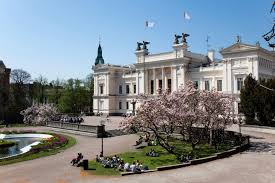
Lund University
Lund University was founded in 1666 and is repeatedly ranked among the world’s top universities. The University has around 46 000 students and 8 500 staff based in Lund, Helsingborg and Malmö. We are united in our efforts to understand, explain and improve our world and the human condition.
Research and education at the Department of Earth and Environmental Sciences (MGeo) addresses fundamental and applied questions on the Earth’s past, present and future climate and environment, including people’s interactions with the natural world and consequences for human wellbeing. MGeo advances and deploys cutting-edge methods, models and technologies in environmental science, quaternary sciences, bedrock geology, paleontology, physical geography, biodiversity and ecosystem science, remote sensing, Geographic Information Science (GIS), and computational science for health and environment, to study processes spanning from the microscopic to the planetary, across all time scales.
The position is based at the Department of Earth and Environmental Sciences (MGeo) at Lund University. The department has over 300 employees, making it one of the largest departments in environmental and geosciences in the Nordic region. It hosts a wide range of research areas and expertise across its five divisions, creating a creative and stimulating work environment.
The doctoral position will be part of a research group focusing on marine environments, particularly benthic microorganisms (foraminifera), and how these can be used to understand and quantify environmental change.
Being a doctoral student
As a doctoral student, you are both admitted as a student and employed at Lund University.
As a doctoral student, you will be trained in a scientific approach. In short, you will be trained to think critically and analytically, to solve problems independently using the right methods, and to develop an awareness of research ethics. In addition, you will have the opportunity to work on projects, to develop your leadership and pedagogical skills. Throughout your studies, you will be guided by supervisors. Doctoral studies end with a thesis and a doctoral degree.
More about being a doctoral student at the Faculty of Science at naturvetenskap.se Doctoral studies | Faculty of Science
Subject and project description
Marine coastal ecosystems are exposed to multiple concurrent stressors, such as deoxygenation, temperature changes, and ocean acidification, which affect biodiversity and ecosystem functioning. Understanding these changes requires knowledge of how biodiversity has varied over longer timescales, but such data are often limited, particularly in marine environments. By studying sediment archives from fjords along the Swedish west coast, where a range of microorganisms are preserved at high resolution, it is possible to reconstruct past changes and elsewhere in both environmental conditions and biodiversity.
In this project, analyses of species assemblages and morphological traits of benthic foraminifera are combined with geochemical proxy data to investigate how biodiversity has varied during the Holocene in relation to climate variability and multiple stressors. Using automated species identification based on machine learning, together with high-resolution 3D analyses using synchrotron-based micro-CT, large and detailed datasets are generated that enable the study of both rapid and gradual processes of change. The overall aim is to understand how marine coastal ecosystems have responded to past environmental changes, thereby improving the ability to predict future developments. The project is funded by the Swedish research council VR
Work duties
You will primarily devote yourself to your doctoral education, which mainly consists of writing a doctoral thesis. During the programme, you will learn a range of methods to study and quantify marine biodiversity and environmental change, with a particular focus on benthic microorganisms in coastal environments. The work includes advanced analytical approaches, such as morphometric studies, automated species identification using machine learning, and geochemical proxy analyses. You will also develop skills in processing and analysing large datasets, as well as in writing scientific publications.
You are expected to actively participate in all parts of the project, from field sampling and handling of sediment cores to laboratory analyses and image-based data analysis. As a researcher, you will also present your results at seminars and international conferences.
The doctoral programme includes both compulsory courses and elective specialised courses that support your development in marine geoscience, data and image analysis, and scientific communication.
In addition to studies, a maximum of 20% of working time may be spent on teaching and other departmental work.
Qualifications
To be eligible for admission and employment as a doctoral student, you must fulfil the requirements below.
Eligibility
Students with basic eligibility for third-cycle studies are those who:
- have completed a second-cycle degree, or
- have completed courses of at least 240 credits, of which at least 60 credits are from second-cycle courses, or
- have acquired largely equivalent knowledge in some other way, in Sweden or abroad.
The employment of doctoral students is regulated in the Swedish Code of Statues 1998: 80. Only those who are or have been admitted to PhD-studies may be appointed to doctoral studentships. When an appointment to a doctoral studentship is made, the ability of the student to benefit from PhD-studies shall primarily be taken into account. In addition to devoting themselves to their studies, those appointed to doctoral studentships may be required to work with educational tasks, research and administration, in accordance with specific regulations in the ordinance.
Additional requirements
In order to complete the doctoral programme in question, the following are also required:
- Documented experience in programming and data analysis, for example in R, Python, or similar
- Ability to work independently and to formulate and address scientific problems
- Good written and oral communication skills in scientific contexts
- Very good command of English, both spoken and written
- Good collaborative skills and strong motivation to work within the field
- Personal qualities such as initiative, reliability, and persistence
Selection criteria
The selection of eligible applicants will be made taking into account the ability to benefit from the training based on the following criteria:
- Relevant subject knowledge in micropaleontology, paleoceanography, marine environments, particularly coastal and fjord systems, or related fields
- Experience of independent scientific work, including problem formulation and analysis
- Experience of fieldwork or other practical research activities
- Experience in handling and analysing sediment or core material
- Documented ability to work independently and in a structured manner
- Experience with microscopy and image-based analytical methods
- Experience with machine learning or image analysis using Dragonfly, ImageJ, Meshlab eller liknande
- Experience with high-resolution imaging techniques, such as micro-CT
We offer
Lund University is a public authority which means that employees get particular benefits, generous annual leave and an advantageous occupational pension scheme. The department offers an inclusive and dynamic work environment with short decision-making paths and good opportunities for professional development. The research group holds regular meetings where current research questions are discussed, both theoretical and practical, as well as developments within the field.
More about working at Lund University on lu.se. https://www.lunduniversity.lu.se/about-university/work-lund-university
Type of employment
Limit of tenure, four years according to HF 5 kap 7§. The employment is a fixed-term employment at full time, starting 2026-09-01 or by the latest 2027-01-01. Third cycle studies at the University consist of full-time studies for 4 years. In the case of teaching and other departmental duties, the employment is extended accordingly.
How to apply
The application should be written in English and you must attach to your application:
- CV and personal letter with a justification of why you are interested in the research education/employment and in what way the research project matches your interests and your educational background.
- Copies of issued study certificates and/or diplomas. These should prove your basic and special eligibility for the doctoral education subject and show that you have the subject knowledge required for the doctoral education project.
- Other information that you wish to refer to (copies of grades, information for references, etc.).
We welcome your application.
Within the Faculty of Science research and education is conducted within Astronomy, Biology, Physics, Geosciences, Chemistry, Mathematics, medical radiation physics, physical geography and Environmental Sciences. The Faculty of Science is organized into eight departments, gathered in the northern campus area in Lund. The Faculty of Science has approximately 1900 students, 330 PhD students and 730 employees.
We kindly decline all sales and marketing contacts.
| Type of employment | Temporary position |
|---|---|
| First day of employment | 2026-09-01 or due agreement |
| Salary | Monthly salary |
| Number of positions | 1 |
| Full-time equivalent | 100 |
| City | Lund |
| County | Skåne län |
| Country | Sweden |
| Reference number | PA2026/1405 |
| Contact | Helena Filipsson, +46462228226, helena.filipsson@mgeo.lu.se |
| Union representative | SEKO: Seko Civil, 046-2229366, sekocivil@seko.lu.seSACO:Saco-s-rådet vid Lunds universitet, 046-2220000, kansli@saco-s.lu.seOFR/ST:Fackförbundet ST:s kansli, 046-2229362, st@st.lu.se |
| Published | 06.May.2026 |
| Last application date | 29.May.2026 |