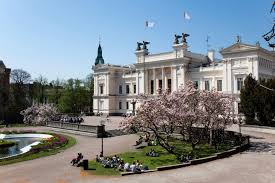
Lund University, The Faculties of Humanities and Theology,
Lund University was founded in 1666 and is repeatedly ranked among the world’s top universities. The University has around 46 000 students and 8 500 staff based in Lund, Helsingborg and Malmö. We are united in our efforts to understand, explain and improve our world and the human condition.
The Department of Archaeology and Ancient History is seeking a postdoctoral researcher for a fixed-term two-year position.
The post is linked to the project ‘Climate Cooling from Volcanic Super-eruptions and European Epidemics during Preindustrial Times’ within the Division of Historical Osteology.
The research project
The project investigates the link between abrupt climate cooling following major volcanic eruptions and outbreaks of infectious diseases, focusing on both ecological mechanisms and how people’s living conditions change as a result of, for example, crop failures, malnutrition, migration and overcrowding. By combining archaeological and historical data with modelling, epidemics of plague, typhoid and cholera are analysed. A new climate-driven human-ecological model for disease spread will be developed and used in both case studies and global simulations. The aim is to provide new insights into how natural disasters, climate change and epidemics are interlinked, with implications for both historical research and the understanding of climate-related health crises.
Tasks and responsibilities
In this project, you will investigate how climate-related crises, deteriorating living conditions and epidemics are reflected in pre-industrial societies through bone material. Quantitative methods and modelling are important tools, but the focus is on interpreting long-term societal changes from an archaeological and historical perspective. Your main task will be to analyse human osteological material from the Iron Age, as well as to select bone material for analysis.
The position is a career development post, and its purpose is to act as an initial step on a career path by providing the opportunity to to deepen and broaden your research expertise. The position also includes some pedagogical training. Teaching, supervision and other teaching-related duties may also be included in the duties, but up to a maximum of one-fifth of the working time.
What we offer
As a Postdoc you are given/provided an opportunity to develop your independence as a researcher with the support of senior colleagues. The appointment is limited to 2 years and is full time in accordance with the Agreement regarding fixed-term employment as a postdoctoral fellow. International employees are supported in their move to Sweden. If you have a family, they will find new contacts and support through Lund’s International Citizen Hub.
Lund University is a government agency, which means that you get special benefits, generous holidays and a favourable occupational pension. Find out more on the University website about working with us Work at Lund University | Lund University.
Read more abour the Department of Archaeology and Ancient History here: Department of Archaeology and Ancient History.
Ready to shape the future of research? Find more reasons why Lund University and the HT Faculties is right for you here, and learn more about Working in Lund, Moving to Lund and Living in Lund.
Qualifications
The position requires a PhD in historical osteology, bioarchaeology or another related subject relevant to the project’s focus. The degree must normally have been obtained no more than three years prior to the closing date for applications, unless there are special circumstances. The applicant must have documented academic ability and a very good command of spoken and written English.
The assessment will primarily be based on your research merits and your potential as a researcher. Particular emphasis will be placed on research competence within the subject area.
Qualification requirements
- Doctoral degree or equivalent international degree in historical osteology, bioarchaeology, or another related subject relevant to the project’s focus. This requirement must be fulfilled no later than the date on which the employment decision is made, and as an applicant, you are responsible for supplementing your application with documentation that confirms the completed doctoral degree.
- Good ability to develop and carry out high-quality research.
- Teaching skills.
- You have not previously been employed as a postdoc researcher under the existing agreement on fixed-term postdoc employment for more than one year in the same or a related subject area with Lund University.
- Documented experience of conducting demographic research on archaeological/historical issues
- The ability to work in a structured and independent manner
- Good teamwork skills
- Excellent verbal and written communication skills in English
Desired qualifications
- Completed doctoral degree no more than three years prior to the application deadline. If there are special circumstances such as leave of absence because of illness, parental leave, position as elected representative in trade union organisations, military service or service/assignments relevant to the subject area, this time can be deducted from the time elapsed since the doctoral degree was completed.
- Experience of using scientific methods relevant to the research task, such as modelling of 14C dates and the use of DNA to identify infectious diseases
- Experience of working on interdisciplinary projects
Terms
The appointment is limited to 2 years and is full time in accordance with the Agreement regarding fixed-term employment as a postdoctoral fellow.
How to apply
Your application should be written in English and include:
• a CV
• a personal letter explaining your interest in the position and how it matches your qualifications
• a copy of your doctoral degree certificate
• a list of publications (including DOI, ISBN or ISSN numbers)
• a doctoral thesis
In addition to the doctoral thesis, it is possible to submit up to five publications.
About The Joint Faculties of the Humanities and Theology
The Joint Faculties of the Humanities and Theology have seven departments and carries out large and varied work within research and education with the purpose to understand people as cultural and social beings. The faculties have around 700 employees and around 4000 students.
About the Department of Archeology and Ancient History
The Department of Archeology and Ancient History at Lund University is one of the oldest and largest archaeological departments in Sweden and offers a vital environment for research and teaching.
The department consists of four subjects: classical archaeology and ancient history, archaeology, historical archaeology and historical osteology, which partly work with different source materials, methods and theoretical perspectives. This is the department’s strength from both a research and educational point of view. Our students often combine our various subjects in their studies to obtain a personally adapted degree.
We kindly decline all sales and marketing contacts.
| Type of employment | Temporary position |
|---|---|
| Contract type | Full time |
| First day of employment | 1 October 2026 or by agreement |
| Salary | Monthly salary |
| Number of positions | 1 |
| Full-time equivalent | 100 |
| City | Lund |
| County | Skåne län |
| Country | Sweden |
| Reference number | PA2026/1385 |
| Contact | Torbjörn Ahlström, Project Leader, torbjorn.ahlstrom@ark.lu.se |
| Union representative | SACO:Saco-s-rådet vid Lunds universitet, 046-2220000, kansli@saco-s.lu.seOFR/ST:Fackförbundet ST:s kansli, 046-2229362, st@st.lu.seSEKO: Seko Civil, 046-2229366, sekocivil@seko.lu.se |
| Published | 06.May.2026 |
| Last application date | 08.Jun.2026 |