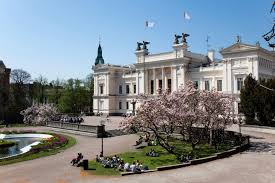
The Department of Physics is with a staff of about 350 scientists and educators one of the largest departments within Lund University. There are seven research divisions and a number of research centra within the department. The research activities at the department cover a broad spectrum of modern physics.
The Division of Synchrotron Radiation Research at the Department of Physics and has about 50 employees. The focus of the research is on experimental studies of electronic, structural, and chemical properties of materials, as well as on accelerators and instrumentation for Synchrotron radiation. The Division of Solid State Physics at the Department of Physics, extensive research is conducted focusing on various aspects of nanophysics, ranging from materials science to bio- and quantum physics to various applications.
NanoLund is the Centre for Nanoscience at Lund University. NanoLund is today Sweden’s largest research environment for nanoscience, engaging more than 400 PhD students and scientists in the Faculties of Engineering, Science, and Medicine. It also operates Lund Nano Lab, a state-of-the-art cleanroom for the synthesis, processing, and characterization of semiconductor nanostructures.
Being a doctoral student
As a doctoral student, you are both admitted as a student and employed at Lund University.
As a doctoral student, you will be trained in a scientific approach. In short, you will be trained to think critically and analytically, to solve problems independently using the right methods, and to develop an awareness of research ethics. In addition, you will have the opportunity to work on projects, to develop your leadership and pedagogical skills. Throughout your studies, you will be guided by supervisors. Doctoral studies end with a thesis and a doctoral degree.
More about being a doctoral student at the Faculty of Science at naturvetenskap.se Doctoral studies | Faculty of Science
Subject and project description
This position will be linked to a major new project financed by the European Innovation Council: Picosecond-scale Photonic Heterogeneous Integrated Neuromorphic Detector (Phinder). The project will enable picosecond-scale, high throughput, optical event detection and analysis by fabricating and demonstrating a dynamic photonic sensor array with on-chip neuromorphic intelligence. This is enabled by significantly advancing the state of the art in optoelectronic algorithm-hardware co-design and multi-scale heterogeneous integration. A central aim of the work at Lund University is to fabricate III-V nanowire based neural nodes communicating at telecom wavelengths and functioning as sensors at variable wavelengths, while also verifying eventual performance levels for spikes at the picosecond time and femtosecond energy scale. The project will be interdisciplinary and involve groups across Europe that work on optoelectronic architecture, sensor geometries and algorithms and integration with advanced waveguiding platforms.
Work duties
You will primarily devote yourself to your doctoral education, which mainly consists of writing a doctoral thesis. You are expected to participate in a research project, doctoral courses, seminars and conferences.
The project takes its starting point in high performance nanostructures developed for solar-energy harvesting and light emitting diodes and will use them for building artificial neural components that use light for interconnects and electrical signals for memory and signal analysis. You will work on developing and exploring the synthesis, processing, properties, and performance of nanowire-based devices for nanophotonic based neuromorphic computing and optical sensing. Your work will include design, modelling, realization, and characterisation of nanophotonic devices based on group III-V materials. The work will engage researchers across different scientific disciplines that collaborate.
The position is placed at department of Physics. Central will be significant collaborations within the large interdisciplinary environment NanoLund (www.nano.lu.se) and will involve many other students and researchers in the environment and in the European project Phinder. Participation in several PhD schools (e.g. on nanoscience, experimental methods and analysis and advanced microscopy) is offered.
In addition to studies, a maximum of 20% of working time may be spent on teaching and other departmental work.
Qualifications
To be eligible for admission and employment as a doctoral student, you must fulfil the requirements below.
Admission requirements
A person meets the general admission requirements for third-cycle courses and study programmes if the applicant:
- has been awarded a second-cycle qualification, or
- has satisfied the requirements for courses comprising at least 240 credits of which at least 60 credits were awarded in the second cycle, or
- has acquired substantially equivalent knowledge in some other way in Sweden or abroad.
A person meets the specific admission requirements for third cycle studies in physics, nanoscience, material science if the applicant has:
- completed an independent work (e.g. degree project) in a relevant subject comprising at least 30 credits. The special qualification may also have been obtained through other equivalent education, which is assessed on a case-by-case basis. In order to enable interdisciplinary initiatives and significant in-depth studies in certain areas, qualifications other than the applicant’s subject-specific competence in material science and/or photonics may be taken into account.
Additional requirements
In order to complete the doctoral programme in question, the following are also required:
- good ability to work independently and to formulate and tackle research problems.
- good written and oral communication skills
- good ability to cooperate
- very good knowledge of English, spoken and written
Selection criteria
The selection of eligible applicants will be made taking into account the ability to benefit from the training based on the following criteria:
- knowledge in the project area as specified above
- motivation for the project as described above
- experience in synthesis, fabrication, measurements and modelling related to nanophotonic devices
- experience in synthesis of nanostructures using CVD based methods.
- experience in laboratory work, including advanced optical, electronic or other characterization tools
- scientific interaction with researchers from other disciplines and from other countries.
- consideration will also be given to good collaborative skills, drive and independence, and how the applicant, through his or her experience and skills, is deemed to have the abilities necessary for successfully completing the third cycle programme.
We offer
Lund University is a public authority which means that employees get particular benefits, generous annual leave and an advantageous occupational pension scheme.
More about working at Lund University on lu.se. https://www.lunduniversity.lu.se/about-university/work-lund-university
About the employment
The employment is a fixed-term employment at full time, starting as soon as possible. Third cycle studies at the Science Faculty consist of full-time studies for 4 years. In the case of teaching and other departmental duties, the employment is extended accordingly. Doctoral studentships are regulated in the Higher Education Ordinance (1993:100), chapter 5, 1-7 §§.
More about terms of employment for doctoral students on Lund University’s Staffpages. https://www.staff.lu.se/research-and-education/research-support/doctoral-education/terms-employment-doctoral-students
How to apply
The application should be written in English and you must attach to your application:
- CV and personal letter with a justification of why you are interested in the training place/employment and in what way the research project matches your interests and your educational background.
- Copies of issued study certificates and/or diplomas. These should prove your basic and special eligibility for the doctoral education subject and show that you have the subject knowledge required for the doctoral education project.
- Other information that you wish to refer to (copies of grades, information for references, letters of recommendation, etc.).
We welcome your application.
Within the Faculty of Science research and education is conducted within Astronomy, Biology, Physics, Geosciences, Chemistry, Mathematics, medical radiation physics, physical geography and Environmental Sciences. The Faculty of Science is organized into eight departments, gathered in the northern campus area in Lund. The Faculty of Science has approximately 1900 students, 330 PhD students and 730 employees.
The Department of Physics is one of Lund University’s largest departments with approximately 400 employees. The department is shared between the Faculty of Science and Faculty of Engineering. At the department there are seven research divisions and a number of major research centra. The research at the department covers a wide range of modern physics.
www.fysik.lu.se/en/
We kindly decline all sales and marketing contacts.
| Type of employment | Temporary position |
|---|---|
| First day of employment | As soon as possible |
| Salary | Monthly salary |
| Number of positions | 1 |
| Full-time equivalent | 100 |
| City | Lund |
| County | Skåne län |
| Country | Sweden |
| Reference number | PA2026/472 |
| Contact | Anders Mikkelsen, anders.mikkelsen@fysik.lu.se |
| Union representative | OFR/ST:Fackförbundet ST:s kansli, 046-2229362, st@st.lu.seSACO:Saco-s-rådet vid Lunds universitet, kansli@saco-s.lu.se, kansli@saco-s.lu.se |
| Published | 24.Mar.2026 |
| Last application date | 30.Apr.2026 |
About the Author
