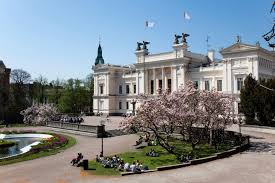
Lund University
Lund University was founded in 1666 and is repeatedly ranked among the world’s top universities. The University has around 46 000 students and 8 500 staff based in Lund, Helsingborg and Malmö. We are united in our efforts to understand, explain and improve our world and the human condition.
Research and education at the Department of Earth and Environmental Sciences (MGeo) addresses fundamental and applied questions on the Earth’s past, present and future climate and environment, including people’s interactions with the natural world and consequences for human wellbeing. MGeo advances and deploys cutting-edge methods, models and technologies in environmental science, quaternary sciences, bedrock geology, paleontology, physical geography, biodiversity and ecosystem science, remote sensing, Geographic Information Science (GIS), and computational science for health and environment, to study processes spanning from the microscopic to the planetary, across all time scales.
Subject description
Our research group has mapped Sweden’s most natural primary (also called old-growth) forests and compared them with production forests. We have shown that natural forests differ significantly from managed forests in terms of function, such as drought tolerance and carbon storage, but we still lack data on how these forest types differ in terms of biodiversity. This project will focus on comparing different biodiversity indicators between primary forests and managed forests, with a focus on Sweden’s most natural lowland boreal old-growth forests.
The main task is to collect relevant data on the condition of the forests and to statistically analyze differences in the abundance/diversity of various organism groups, as well as how this abundance/diversity varies across different scales and due to different geographical factors. The work may also involve detailed analyses of how different aspects of biodiversity are promoted by forest structures, continuity, and connectivity, as well as any potential effects of biodiversity on forest ecosystems. The project focuses on ants, birds, and plants.
Work duties
The main duties involved in a post-doctoral posistion is to conduct research. Teaching may also be included, but up to no more than 20% of working hours. The position shall include the opportunity for three weeks of training in higher education teaching and learning.
The specific work involves data collection and analysis of biodiversity indicators from existing primary forests as well as forests that have been harvested at different points in time. The work involves extensive fieldwork, data analysis using geographic datasets, spatial analyses, and statistical programs/computational tools.
The position is therefore suitable for a person who is prepared to spend a lot of time in the field, covering large distances on foot, and who has a strong background in biodiversity, a strong interest in environmental issues, a solid foundation in quantitative methods such as mathematics, statistics, and programming, broad knowledge of natural and anthropogenic processes affecting biodiversity and forest function, and a willingness to conduct fieldwork in remote and physically demanding environments.
The post-doctoral-fellow will be part of a research group focused on understanding human impacts on boreal forests. This may involve participation in related studies and data collection efforts.
See https://www.youtube.com/watch?v=cIw3PekWDRM for an insight into what we have done previously and what the fieldwork can involve.
Qualification requirements
Appointment to a post-doctoral position requires that the applicant has a PhD, or an international degree deemed equivalent to a PhD, within the subject of the position, completed no more than three years before the date of employment decision. Under special circumstances, the doctoral degree can have been completed earlier.
Additional requirements:
- Very good oral and written proficiency in English.
- Very good knowledge of computer-based calculations, GIS and programming
- PhD degree in Science
Assessment criteria and other qualifications
This is a career development position primarily focused on research. The position is intended as an initial step in a career, and the assessment of the applicants will primarily be based on their research qualifications and potential as researchers. Particular emphasis will be placed on research skills within the subject.
For appointments to a post-doctoral position, the following shall form the assessment criteria:
- A good ability to develop and conduct high quality research.
- Teaching skills.
Additional assessment criteria:
- Field work expereince
- Drivers license
- Experience of field inventory of biodiversity
- Experience of analysis of data, especially data on biodiversity
- Good knowledge in GIS
- Good knowledge in quantitative methods
- Good knowledge in programming, calculation tools (such as matlab, python or R), and statistics
- Expereince in formulating and answering research questions
- Knowledge in boreal forests, forest management and Swedish forest history
Consideration will also be given to good collaborative skills, drive and independence, and how the applicant’s experience and skills complement and strengthen ongoing research within the department, and how they stand to contribute to its future development.
Terms of employment
This is a full-time, fixed-term employment of a maximum of XX years. The period of employment is determined in accordance with the agreement “Avtal om tidsbegränsad anställning som postdoktor” (“Agreement on fixed-term employment as a post-doctoral fellow”) between Lund University, SACO-S and OFR/S, dated 1st February 2022.
Instructions on how to apply
Applications shall be written in English and be compiled into a PDF-file containing:
- résumé/CV, including a list of publications,
- a general description of past research and future research interests (no more than one page),
- contact information of at least two references,
- copy of the doctoral degree certificate, and other certificates/grades that you wish to be considered.
Welcome with your application!
Within the Faculty of Science research and education is conducted within Astronomy, Biology, Physics, Geosciences, Chemistry, Mathematics, medical radiation physics, physical geography and Environmental Sciences. The Faculty of Science is organized into eight departments, gathered in the northern campus area in Lund. The Faculty of Science has approximately 1900 students, 330 PhD students and 730 employees.
We kindly decline all sales and marketing contacts.
| Type of employment | Temporary position |
|---|---|
| Contract type | Full time |
| First day of employment | Början av juni enligt överenskommelse |
| Salary | Månadslön |
| Number of positions | 1 |
| Full-time equivalent | 100 |
| City | Lund |
| County | Skåne län |
| Country | Sweden |
| Reference number | PA2026/1300 |
| Contact | Anders Ahlström, 0732028487, anders.ahlstrom@mgeo.lu.se |
| Union representative | SEKO: Seko Civil, 046-2229366, sekocivil@seko.lu.seOFR/ST:Fackförbundet ST:s kansli, 046-2229362, st@st.lu.seSACO:Saco-s-rådet vid Lunds universitet, 046-2220000, kansli@saco-s.lu.se |
| Published | 27.Apr.2026 |
| Last application date | 24.May.2026 |