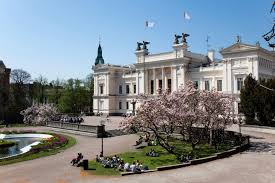
Lund University
Lund University was founded in 1666 and is repeatedly ranked among the world’s top universities. The University has around 46 000 students and 8 500 staff based in Lund, Helsingborg and Malmö. We are united in our efforts to understand, explain and improve our world and the human condition.
Description of the workplace
The position is located at the Division of Evolutionary Ecology and Infection Biology, Department of Biology, Lund University. The department employs over 300 people, making it one of the largest biology departments in the Nordic region. Covering a large number of research areas and competences, the Department of Biology is an international, creative and stimulating workplace. This doctoral student position is in the Lund Migration Group, a large research group focused on understanding all aspects of animal migration and consisting of several specialized labs.
Being a doctoral student
As a doctoral student, you are both admitted as a student and employed at Lund University.
As a doctoral student, you will be trained in a scientific approach. In short, you will be trained to think critically and analytically, to solve problems independently using the right methods, and to develop an awareness of research ethics. In addition, you will have the opportunity to work on projects, to develop your leadership and pedagogical skills. Throughout your studies, you will be guided by supervisors. Doctoral studies end with a thesis and a doctoral degree.
More about being a doctoral student at the Faculty of Science at naturvetenskap.se
Project description
Twice a year billions of birds track the seasonal pulse of the earth and move between breeding sites and wintering sites. Successfully migrating between remote areas is a delicate process where birds must navigate a series of novel environments, and carefully time their journeys based on both environmental and internal cues. So, it’s no surprise that migration is a perilous time, when birds are particularly exposed to disruptions of different kinds. In this project you will use data from the European weather radar network to investigate how different disruptors can affect large scale flows of nocturnal migrants. The overall goal is to test if potential disruptors have detectable effects on the flow of nocturnal migration. The results will answer important fundamental questions about how robust animal migration is to different types of disruptors, enabling us to better understand the evolutionary pressures that have shaped animal migration, and how these pressures will interact with our changing world in the future.
Work duties
You will primarily devote yourself to your doctoral education, which mainly consists of writing a doctoral thesis. During the training you will learn to analyse large amounts biological data extracted from weather radar data, advanced analysis methods and to write scientific papers. You are expected to actively participate in the ongoing research projects in the lab group and to plan and carry out your own analyses of large-scale bird migration patterns. As a researcher, you will also present your research by participating in seminars and international conferences. The doctoral training also includes a number of mandatory courses and voluntary special courses that contribute to your development in solving and presenting scientific questions.
In addition to studies, a maximum of 20% of working time may be spent on teaching and other departmental work. Depending on your background, you may teach basic courses in Biology or advanced courses such as Ornithology or Animal Ecology.
Qualifications
To be eligible for admission and employment as a doctoral student, you must fulfil the requirements below.
Admission requirements
A person meets the general admission requirements for third-cycle courses and study programmes if the applicant:
- has been awarded a second-cycle qualification, or
- has satisfied the requirements for courses comprising at least 240 credits of which at least 60 credits were awarded in the second cycle, or
- has acquired substantially equivalent knowledge in some other way in Sweden or abroad.
A person meets the specific admission requirements for third cycle studies in Biology if the applicant has:
- completed an independent work (e.g. degree project) in a relevant subject comprising at least 30 higher education credits The special qualification may also have been obtained through other equivalent education, which is assessed on a case-by-case basis. In order to enable interdisciplinary initiatives and significant in-depth studies in certain areas, qualifications other than the applicant’s subject-specific competence in Biology may be taken into account.
Additional requirements
In order to complete the doctoral programme in question, the following are also required:
- good ability to work independently and to formulate and tackle research problems.
- good written and oral communication skills
- good ability to cooperate
- very good knowledge of English, spoken and written
Selection criteria
The selection of eligible applicants will be made taking into account the ability to benefit from the training based on the following criteria:
Knowledge and skills relevant to the dissertation work and the educational subject. Assessed ability to work independently and ability to formulate and address scientific problems.
- Capacity to analyse large datasets.
Consideration will also be given to good cooperation skills, drive and independence, and how the applicant, through their experience and competence, is assessed to have the ability needed to complete the doctoral education.
We offer
Lund University is a public authority which means that employees get particular benefits, generous annual leave and an advantageous occupational pension scheme.
With its long history at the forefront of bird migration research, our department offers a unique research environment of world leading experts as well as specialized infrastructure, including an electronics lab for developing tracking devices, state-of-the-art facilities for orientation studies and a unique wind tunnel. Furthermore our unit has a non-hierarchical, inclusive, dynamic and creative work environment where you have the best conditions to develop. The Lund Migration Group has regular meetings where we discuss current research and the department also offers exciting guest lectures every week and an annual PhD student conference.
More about working at Lund University on lu.se.
About the employment
The employment is a fixed-term employment at full time, starting 1 September 2026 or as agreed. Third cycle studies at Lund University consist of full-time studies for 4 years. In the case of teaching and other departmental duties, the employment is extended accordingly. Doctoral studentships are regulated in the Higher Education Ordinance (1993:100), chapter 5, 1-7 §§.
More about terms of employment for doctoral students on Lund University’s Staffpages.
How to apply
The application should be written in English and you must attach to your application:
– CV and personal letter with a justification of why you are interested in the employment and in what way the research project matches your interests and your educational background.
– Copies of issued study certificates and/or diplomas. These should prove your basic and special eligibility for the doctoral education subject and show that you have the subject knowledge required for the doctoral education project.
– Other information that you wish to refer to (copies of grades, information for references, letters of recommendation, etc.).
We welcome your application!
Within the Faculty of Science research and education is conducted within Astronomy, Biology, Physics, Geosciences, Chemistry, Mathematics, medical radiation physics, physical geography and Environmental Sciences. The Faculty of Science is organized into eight departments, gathered in the northern campus area in Lund. The Faculty of Science has approximately 1900 students, 330 PhD students and 730 employees.
We kindly decline all sales and marketing contacts.
| Type of employment | Temporary position |
|---|---|
| First day of employment | 2026-09-01 or according to agreement |
| Salary | Monthly salary |
| Number of positions | 1 |
| Full-time equivalent | 100 |
| City | Lund |
| County | Skåne län |
| Country | Sweden |
| Reference number | PA2026/1368 |
| Contact | Cecilia Nilsson, Researcher, +46707363916, cecilia.nilsson@biol.lu.se |
| Union representative | SEKO: Seko Civil, 046-2229366, sekocivil@seko.lu.seOFR/ST:Fackförbundet ST:s kansli, 046-2229362, st@st.lu.seSACO:Saco-s-rådet vid Lunds universitet, 046-2220000, kansli@saco-s.lu.se |
| Published | 04.May.2026 |
| Last application date | 01.Jun.2026 |